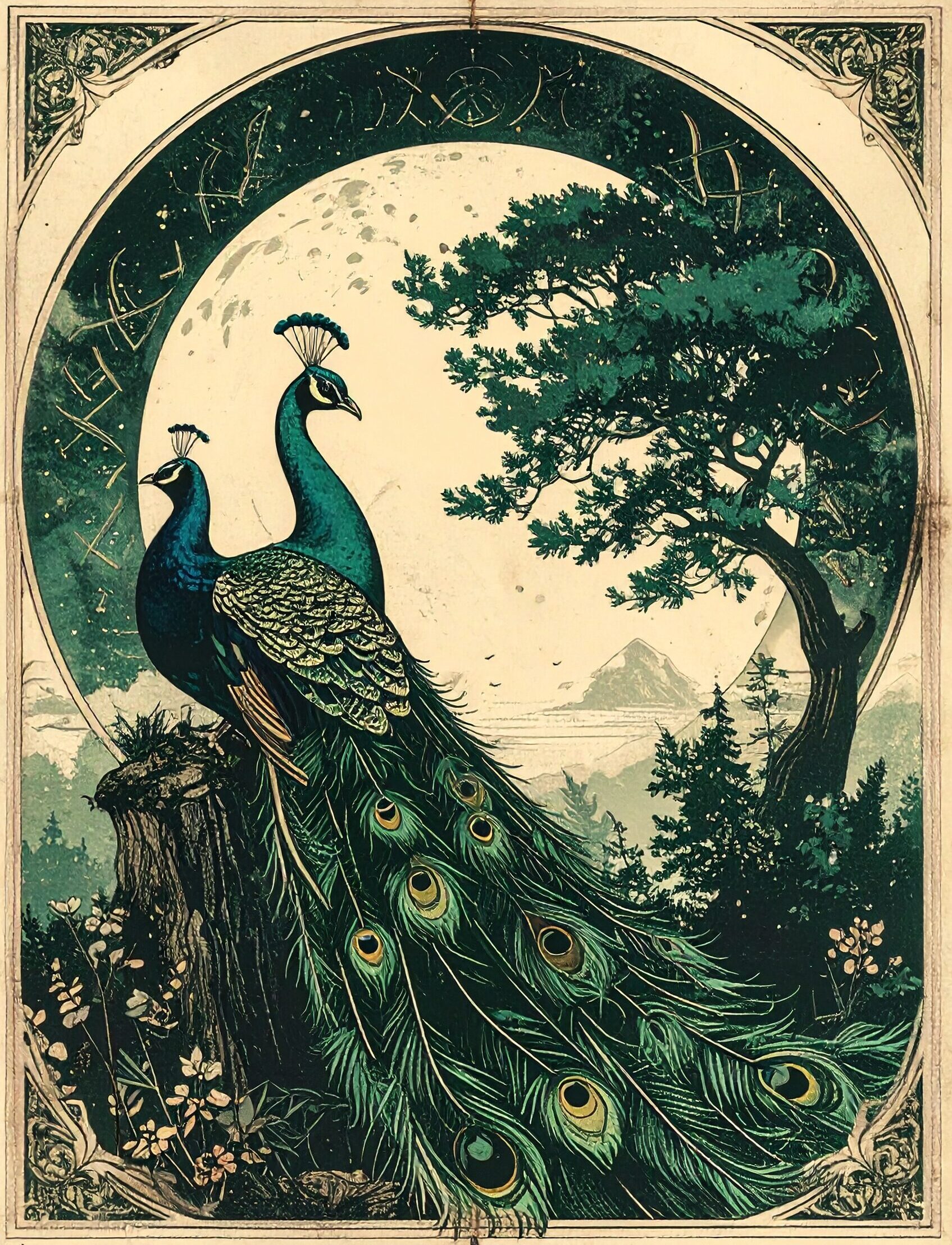
The question gets asked in different ways. Some people whisper it in shame, afraid that admitting they’re drawn to both Christ and the moon will get them excommunicated from both communities at once. Some ask it as a polemical challenge, isn’t that a contradiction? Some ask it with hope, having spent years feeling like they have to choose.
The short answer is yes. The longer answer, the one worth your time, is why yes, and what that actually looks like in practice.
What “Pagan” Originally Meant
The word pagan comes from the Latin paganus, meaning “rural person” or “country-dweller.” In the late Roman Empire, when Christianity became the official religion of the cities, the older earth-honoring religions persisted longer in the countryside. Paganus became shorthand for “the people who still practice the old ways.”
It was, in other words, a geographical and cultural term before it was a theological one. It meant the people of the land. And the people of the land have always been those whose spirituality was rooted in the seasons, the soil, the local rivers and forests and stars.
This is worth pausing on. Because if “pagan” originally meant “earth-rooted spiritual person,” then the entire framing of pagan-vs-Christian becomes much less clear. The earliest Christians, after all, were also people of the land. They walked in gardens. They spoke in parables about seeds and sparrows. They marked sacred time by the agricultural calendar.
What Early Christianity Actually Was
The Christianity of the first three centuries was wildly diverse. It absorbed local practices, festivals, and symbols. Christmas was set near the winter solstice in part because the winter solstice was already a sacred day. Easter takes its name from Eostre, a pre-Christian goddess of spring. The candles, the incense, the pilgrimages to sacred natural sites, all of these came from older traditions and were carried forward.
The historical record is one of constant both/and. The institutional church’s later insistence on either/or, pagan or Christian, never both, is a much younger development, codified by particular bishops in particular centuries for particular reasons. It is not the only legitimate way to read the tradition.
What the Pagan Church of Christ Actually Holds
We are not arguing for a return to first-century practice. We are arguing for an honest reckoning: the wisdom of earth-honoring traditions and the wisdom of Christ are not, and have never been, fundamentally opposed. They have been pitted against each other by people with particular interests. We can choose to stop.
What we hold:
- The teachings of Christ are central. Love one another. Care for the poor. The kingdom of God is within you. Consider the lilies. These are not optional; they form our moral spine.
- The earth is sacred. Not metaphorically. Actually. The soil, the seasons, the moon, the breath of the trees, these are expressions of the same sacred reality that Christ pointed to when he spoke of the kingdom being among us.
- Practice belongs to community. Spirituality alone in a bedroom with a podcast is thin. We gather, we sing, we pray, we mark the seasons together. This is what makes a church a church.
- No one has to leave themselves at the door. Your questions, your doubts, your sexuality, your love for the wild, these come with you.
The Common Objections
People sometimes push back on this with biblical verses. The Old Testament has strong prohibitions against worshipping “other gods,” against witchcraft, against divination. Doesn’t that settle it?
Not really. Here’s why:
First, the prohibitions in question were aimed at very specific practices in very specific historical contexts, child sacrifice, foreign empires’ state religions, court magicians who used spiritual claims to manipulate political power. They were not aimed at, say, lighting a candle on the new moon or noticing that the trees are beautiful.
Second, the Bible itself is full of imagery that earth-honoring traditions would recognize as their own. The burning bush. The pillar of cloud. The dove descending. The river. The bread. The fish. The grain. Christianity that severs itself from the earth has always been doing violence to its own scriptures.
Third, the question of which prohibitions still bind contemporary Christians is itself a debated one. Most Christians eat shellfish, wear mixed fabrics, and don’t keep kosher, all explicitly prohibited in the same texts. The principle of charitable, contextual reading is not selective when applied to pagan practice; it’s just consistent.
What It Looks Like in Practice
In our community, both/and shows up in concrete ways:
- We follow the Christian liturgical calendar, Advent, Lent, Easter, Pentecost, and we follow the wheel of the year and the pagan holy days calendar, Samhain, Yule, Imbolc, Ostara, Beltane, Litha, Lughnasadh, Mabon.
- We pray in the name of Christ, and we also stand in silent attention at the new moon.
- We read the Sermon on the Mount, and we also read the works of earth-honoring elders and ecologists and herbalists.
- We mark births and deaths and griefs and joys with rituals that draw from both wells.
It is not hard to do, once you stop assuming you have to choose. The two traditions complete each other in ways that become obvious in practice.
A Word About Syncretism
Some people will call this syncretism, often as an accusation. They mean it pejoratively, the idea that blending traditions waters them down.
We disagree, for two reasons.
First, the early church was thoroughly syncretic. The Greek and Roman philosophical concepts that frame the Trinity, the Jewish ritual structure that frames the Eucharist, the local festivals absorbed into the liturgical year, all of this is syncretism. The question is not whether to syncretize but what.
Second, the synthesis we practice is not careless. We are not picking what’s emotionally convenient. We are holding what is true: that the sacred is one, that it expresses itself through both the teachings of Christ and the wisdom of the living world, and that gathering to honor it together is what spiritual community has always been for.
If You’ve Been Wrestling With This
If you’ve come to this article from a place of fear, afraid you can’t be both, afraid you’ll be rejected by either community, we want you to know:
You’re not alone. Most of the people who find their way to the Pagan Church of Christ have wrestled with this question. Many of us wrestled with it for years. The wrestling itself is part of the faith.
You don’t have to figure it out before you come. You don’t have to commit to a position. You can simply come to a gathering, sit in a circle, and see what happens.
If you’d like to learn more about how we actually practice this, our About page lays out who we are. Our New to Us guide walks through what to expect at a first gathering. And our contact page tells you how to find our next one.
You don’t have to choose. You can hold both. We do, and the holding is one of the best things we have.
Come sit with us
We gather on Sundays, at the new moon, and midweek. Because we do not have a permanent building yet, we send the time and place by email. Write to info@paganchurchofchrist.org or use the form on our contact page and we will reply with the details for the next one.
Sources & Further Reading
- Robin Lane Fox, Pagans and Christians (Harper & Row, 1986)
- Bart D. Ehrman, How Jesus Became God: The Exaltation of a Jewish Preacher from Galilee (HarperOne, 2014)
- Ronald Hutton, The Pagan Religions of the Ancient British Isles (Blackwell, 1991)
- John Philip Newell, Christ of the Celts (Jossey-Bass, 2008)
- Diana Butler Bass, Grounded: Finding God in the World (HarperOne, 2015)
Keeping a door open for people who arrive holding both traditions at once takes ordinary support, and you can help make sure everyone who walks in is welcomed fully.